
Demolition enters new phase at former HRC property
Former HRC residents return weekly to the Memorial Avenue site, saying the demolition brings relief after decades of memories tied to harm and abuse.
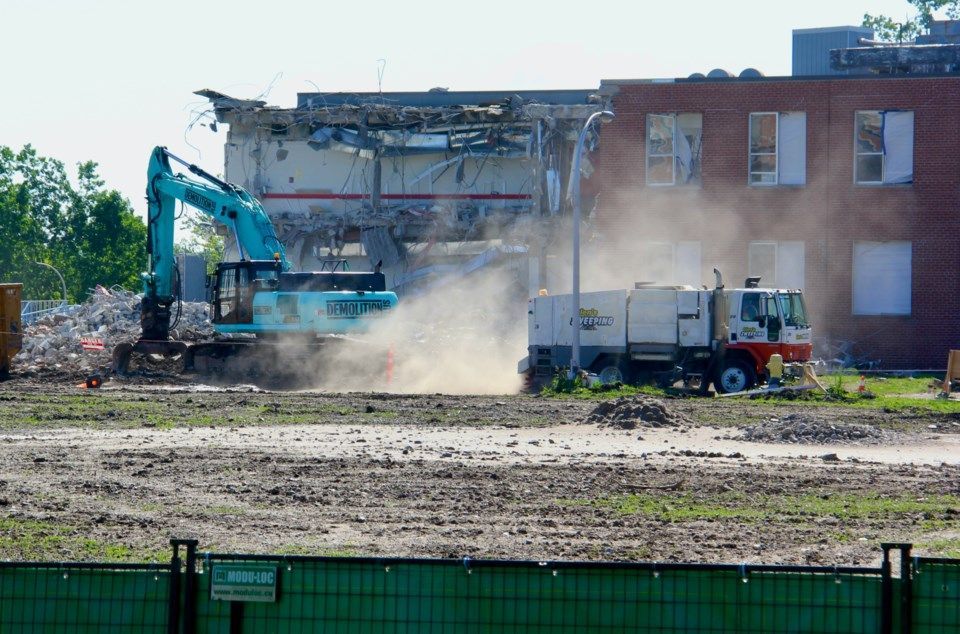
Demolition continues on the former Huronia Regional Centre (HRC) institution in Orillia with work beginning this week on the McGee apartments, the largest single structure on the 175-acre site sprawling along Memorial Avenue.
"I remember that one," said former HRC resident Harold Dougall, 77, who lived elsewhere on site, as did Cindy Scott, 62.
Dougall and Scott, who now both live independently in Orillia, visit the site weekly as they monitor the demolition with glee. The buildings can't come down fast enough for them as the sight of them brings back memories of harm and abuse.
"We want all these buildings down. Every time I go past there, I get shivers for the good because it's coming down," Dougall told OrilliaMatters when the first phase of demolition began in January.
Locally known as the Pav, or the pavilion, the McGee building was used for people with high support needs, including those who needed help with toileting, said Mitchell Wilson, a Barrie researcher.
"It was one of the worst parts of the facility because they didn't get their needs met. According to a former staff member, there was an area with a waist-high partition they called the bullpen, where they herded naked people into it and left them there," said Wilson, a member of Remember Every Name, a group that supports and advocates for survivors.
"I'm keeping a record of the demolition so that we have an archive of material," said Wilson, who was an adviser on the 2022 documentary about the HRC called Unloved: Huronia's Forgotten Children, which is available on CBC Gem.
On Friday, a Bird Construction representative toured Dougall and Scott in a vehicle so they could see the demolition work done to date up close.
Infrastructure Ontario, which owns the property, and Ontario Provincial Police, which uses some of the buildings on site for the police academy, communicate regularly with members of Remember Every Name to keep them apprised of the work being done.
Phase 1 of the demolition tore down two service buildings, Coral Cove Camp, the admission and isolation building, the old infirmary, the multi-sensory house and a long row of one-storey buildings, referred to as the medical infirmary unit.
The Bird representative said the work of tearing down more than 40 buildings with basements and 11 tunnels is labour intensive. It will take about two to three more weeks to complete the tear-down of the McGee apartments, which is two storeys at the front and three storeys at the back.
The next buildings to come down include Cottage D, where Dougall lived, and the nurses residence, which both face Memorial Avenue. The superintendent's house and other houses, which served as group homes, are also coming down.
The HRC was an institution for developmentally disabled people and was operated by the Government of Ontario for 133 years, between 1876 and 2009.
After the institution closed, a class-action suit against the government was launched by advocates for survivors. The lawsuit was a long and arduous process but was settled in 2013 with a total payout of $35 million. The maximum amount survivors received (for those who suffered the most severe abuse) was $42,000. Then-premier Kathleen Wynne apologized to survivors for their trauma.
Last June, Kinga Surma, the province's minister of infrastructure, gave initial approval to demolish, in phases, buildings on the property, which lies between Memorial Avenue and Lake Simcoe.
Article by Gisele Winton Sarvis of orilliamatters.com