Former HRC resident recounts abuse and resilience in new book
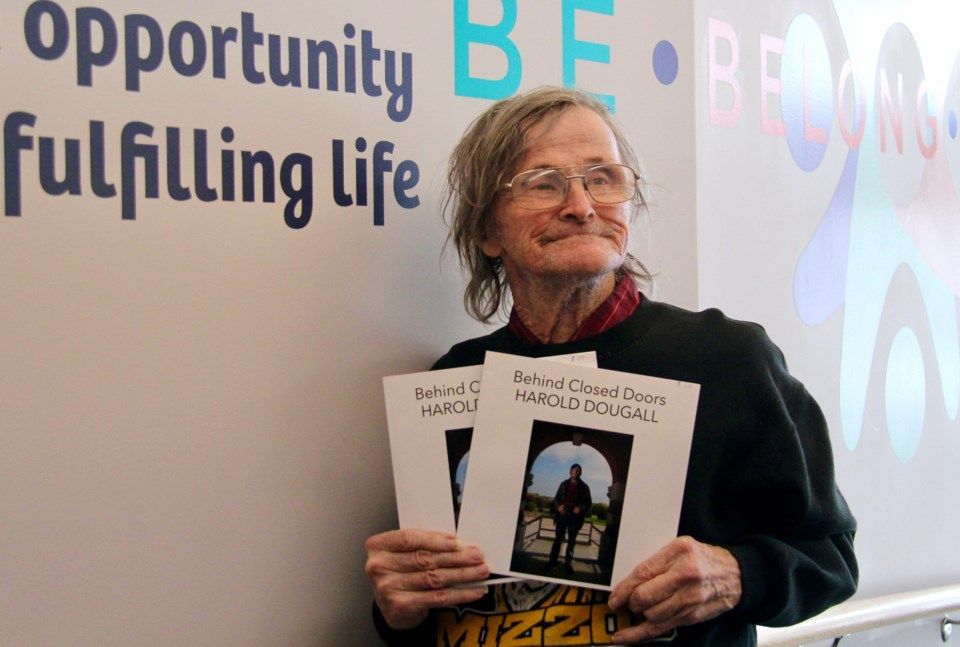
Harold Dougall is a longtime survivor of the former Huronia Regional Centre (HRC), and now he's an author of his story.
The 77-year-old survived the era when people with disabilities were institutionalized behind closed doors and abuses took place.
Behind Closed Doors the title of the new book about Dougall's experience living at the former HRC in Orillia and the Edgar Adult Occupational Centre in Oro-Medonte.
"I'm on Cloud 9," said Dougall. "People are scared to tell their story. I want to let the people know who the story is from ... I want my book out there so people know who I am."
Dougall co-wrote the book with Jay Dolmage, a professor at the University of Waterloo and editor of the Canadian Journal of Disability Studies and Katharine Viscardis, an instructor at Northern Lakes College. Dougall's story will be part of a larger book titled A Disgrace to this Province by Viscardis. It is currently in the editing phase.
Born in Hamilton, Dougall was placed in the care of the Children's Aid Society when he was two years old. Upon advice to do so, his foster mother delivered him to the HRC in 1960, when he was 11.
He writes, "When we arrived at the institution, I didn't want to get out of the car. I walked up the stairs. I said, 'Mom, this is a place I don't need to be.' We stepped into the main lobby there and the door was open. After we stepped inside, I heard 'click' as though the door locked behind us. I asked my mom, 'What's going on here?' A member of staff came down to take me to the cottage and they told my mom, 'Go home and don't come back here.'
"I cried all the way to the cottage (A). The staff said, 'Stop crying or else I'll hit you.' The cottage door opened. It was locked behind me and then they smacked me. Life inside that building was hard. I cried. I cried myself to sleep sometimes."
Dougall wrote that the boys' ward was overcrowded and everyone had to live in a strict military style.
"They just wanted us to keep us in line by using straps, hands and belts. They'd kick us. They'd do anything to keep us in line. Some staff would take their shoes off and use the soles to hit us. They'd hit us anywhere on our bodies," he wrote.
In speaking with OrilliaMatters, Dougall said the children feared the pipe room. It was a hot mechanical room. Staff locked them inside for hours as a form of punishment. Dougall said he remembers being in there and seeing scratches on the door where children were trying to get out.
"If you were bad, they put you in there. One time, I couldn't walk out of there. I had to crawl," he said.
Although there was a school at the HRC, Dougall wasn't sent there, so he received no formal education. He later taught himself how to read and write.
When he turned 12, he was assigned to care for four other boys, and he took that seriously, even taking punishment for defending them from physical abuse.
Despite being told by staff to hit the boys when they argued, Dougall said he talked to them instead. He taught them how to wash themselves. He also used his own money to buy them new toothbrushes and was punished for it. He persisted and taught the boys about money, travelling on buses, and other aspects of the outside world.
In 1962, his foster mother had him transferred to the Edgar Adult Occupational Centre so he could receive occupational training. That environment was far superior to the HRC, said Dougall, and he lived there until 1975.
"They trained me to do grass cutting, to work on cars. That's where I got my licence ... The first thing they started me in was the kitchen there. I loved it ... I felt free," he recalled.
A class-action lawsuit was brought against the province by former HRC residents who suffered sexual, physical and verbal abuse in the institution. Dolmage's parents, Marilyn and Jim Dolmage, who were associated with the HRC, were among the leaders of the lawsuit against. Dougall participated as well but said he wasn't allowed to testify in court.
In 2013, a $35-million settlement was reached, providing compensation to residents who had developmental disabilities. Dougall received some funds from his time at both the HRC and the Edgar Adult Occupational Centre. The HRC operated between 1876 and 2009. The Edgar Adult Occupational Centre operated between 1964 and 1999.
Today, Dougall lives independently in Orillia. He is well known in the community. He has run for city council twice and plans to run again this fall. He has been on the city's accessibility advisory committee. He is a former Special Olympics swimmer. He volunteers to sell buttons for the annual Canada Day celebration and the Scottish Festival.
Dougall is a member of Remember Every Name, a group supporting survivors of the HRC. He is also an advocate for inclusivity and belonging and does public speaking.
Dougall only received about 50 copies of his book, which he is selling for $10.
"Empower Simcoe is supporting Harold to get more reprints of his book," said Jamie Hall, corporate communications manager with Empower Simcoe. "We would like to do a book signing with Harold at the library, but we need copies."
In posting the book to Empower Simcoe's social media pages, Hall said it has had 1,400 interactions and 200 comments of support and notices that people want to buy his book.
"When I look back to the kid I was in Huronia ... I'd day to that little boy, 'Be proud of yourself,'" wrote Dougall.
Written by Gisele Winton Sarvis, OrilliaMatters.com